Build vs Buy: Key Considerations for SaaS Founders
Explore the critical build versus buy decision for SaaS founders, focusing on multi-tenant platforms, scalability, and strategic resource allocation. Learn how to balance development time, costs, and competitive differentiation to choose the right infrastructure for your business.

Zakariae

Every SaaS founder eventually confronts the same pivotal question: should you build your application infrastructure from scratch, or leverage existing platforms and tools to accelerate your path to market? This decision becomes even more consequential when you are developing a multi-tenant platform where clients will create their own applications, manage custom subdomains, and handle complex user hierarchies. The stakes are high because the wrong choice can drain your runway, delay your launch by months, or saddle you with technical debt that compounds over time.
For founders building no-code platforms, app builders, or white-label SaaS solutions, this build versus buy decision takes on additional complexity. You are not simply choosing tools for internal use; you are selecting the foundation upon which your customers will build their businesses. The infrastructure you choose today will determine your scalability ceiling, your maintenance burden, and ultimately your ability to compete in an increasingly crowded market.
This comprehensive guide examines the build versus buy decision through the lens of SaaS founders targeting the US market. We will explore the true costs of each approach, examine hybrid strategies that combine the best of both worlds, and provide a practical framework for making this critical decision with confidence.
Key Takeaways
- The build versus buy decision is fundamentally a business strategy question, not a technical one, and should be evaluated based on where your competitive differentiation lies.
- Building from scratch typically requires 600+ hours of development time for core SaaS features, plus ongoing maintenance that can consume 20-30% of engineering capacity.
- Buying or leveraging existing solutions accelerates time-to-market but may introduce vendor lock-in, subscription costs that scale with growth, and limitations on customization.
- Hybrid approaches using boilerplates and starter kits offer a middle path, providing production-ready foundations while preserving flexibility for customization.
- Multi-tenant architecture requirements significantly increase complexity, making the case for leveraging existing solutions even stronger for most founders.
- Total cost of ownership calculations must include hidden costs like security maintenance, compliance updates, and opportunity costs of delayed launches.

Understanding the Core vs. Context Framework
Before diving into specific platforms and tools, founders must establish a clear framework for evaluating where to invest their limited engineering resources. The most effective model for this decision comes from Geoffrey Moore's Core vs. Context framework, which distinguishes between activities that differentiate your business and those that simply keep it running.
Core activities represent your unique value proposition. These are the features and capabilities that customers specifically choose you for over competitors. For a no-code platform builder, this might be your drag-and-drop interface, your unique component library, or your proprietary logic system that makes complex workflows accessible to non-technical users.
Context activities are everything else required to operate your business. Authentication systems, payment processing, email delivery, user management, and basic CRUD operations fall into this category. While these systems are mission-critical, they do not differentiate you in the marketplace. Your customers do not choose your platform because you have excellent password reset functionality.
The golden rule emerging from this framework is straightforward: invest your engineering talent in Core activities, and buy or leverage existing solutions for Context. When you find yourself building custom software for user authentication, subscription billing, or basic admin dashboards, you are likely allocating scarce resources to non-differentiating activities that could be handled by existing solutions.
This framework becomes particularly relevant when evaluating a cloud based app development platform for your SaaS venture. The platform you choose should handle as much Context as possible while giving you maximum flexibility to build your Core differentiators. Understanding this distinction helps founders avoid the common trap of over-engineering commodity features while under-investing in the capabilities that actually matter to customers.
The True Cost of Building from Scratch
Many technical founders underestimate the total cost of building SaaS infrastructure from scratch. The initial development is only the beginning; the ongoing maintenance, security updates, and feature parity with evolving market expectations create a long tail of costs that can consume your engineering capacity for years.
Consider the core features required for any modern multi-tenant SaaS platform: authentication with multiple providers, role-based access control, subscription management, payment processing, email systems, admin dashboards, user management, and API infrastructure. Building these features to production quality typically requires 600+ hours of development time, assuming experienced developers who have built similar systems before.
| Feature Category | Estimated Development Hours | Annual Maintenance Hours |
|---|---|---|
| Authentication System | 80-120 hours | 20-40 hours |
| Multi-tenant Architecture | 100-150 hours | 30-50 hours |
| Subscription & Billing | 60-100 hours | 20-30 hours |
| Admin Dashboard | 80-120 hours | 15-25 hours |
| Email System | 40-60 hours | 10-20 hours |
| User Management | 60-80 hours | 15-25 hours |
| Custom Domains & SSL | 40-80 hours | 20-40 hours |
| API Infrastructure | 60-100 hours | 20-30 hours |
At typical US developer rates of $100-200 per hour, the initial development alone represents a $60,000-$150,000 investment. But the hidden costs extend far beyond initial development. Security vulnerabilities must be patched promptly, often within hours of disclosure. Compliance requirements evolve, requiring updates to data handling and privacy features. Third-party APIs change their interfaces, breaking integrations that must be fixed immediately.
Perhaps most significantly, building from scratch delays your time-to-market. Every month spent building authentication systems and admin dashboards is a month your competitors are acquiring customers, gathering feedback, and iterating on their Core features. For early-stage startups, this opportunity cost often exceeds the direct development costs by a substantial margin.
The Hidden Costs of Pure SaaS Adoption
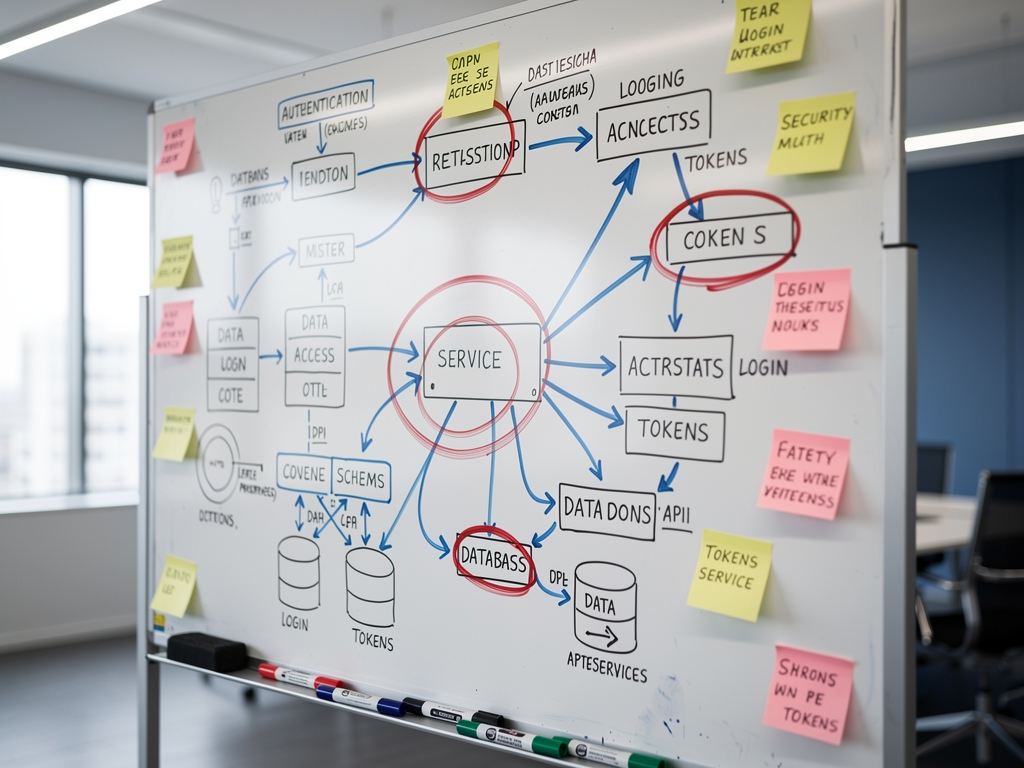
On the opposite end of the spectrum, founders who rely entirely on third-party SaaS tools face their own set of challenges. While the initial deployment is fast and the upfront costs are low, the long-term implications can be equally problematic for certain business models.
Subscription costs scale with success. Most SaaS tools price based on users, transactions, or usage volume. What starts as a $50/month tool can become a $5,000/month expense as your platform grows. For multi-tenant platforms where you are managing thousands of end users across hundreds of client accounts, these costs can quickly erode your margins.
Vendor lock-in creates strategic risk. When your core infrastructure depends on third-party services, you inherit their roadmap decisions, pricing changes, and business continuity risks. A vendor acquisition, pivot, or shutdown can force emergency migrations that disrupt your business and frustrate your customers.
Customization limitations constrain your product. SaaS tools are designed to serve broad markets, which means they optimize for common use cases rather than your specific requirements. The workflow that would perfectly serve your customers may be impossible to implement within the constraints of your chosen tools.
Integration complexity compounds over time. Connecting five or six SaaS tools through APIs and automation platforms like Zapier creates a fragile web of dependencies. Each tool has its own authentication, rate limits, and failure modes. Debugging issues across multiple systems becomes increasingly difficult as your integration complexity grows.
One founder's experience illustrates this challenge vividly. After spending eight months stitching together Airtable, Zapier, Typeform, HubSpot, and a custom Webflow CMS to manage client workflows, the combined subscription costs reached $900/month. Over three years, that totaled over $32,000, more than the cost of a custom solution that would have been faster, more reliable, and fully owned.
Critical Insight: The build versus buy decision should not be framed as an either/or choice. The most successful SaaS founders find hybrid approaches that leverage existing solutions for Context while preserving flexibility to build their Core differentiators.
The Hybrid Approach: Boilerplates and Starter Kits
Between building everything from scratch and relying entirely on third-party SaaS tools lies a powerful middle path: leveraging boilerplates, starter kits, and production-ready foundations that accelerate development while preserving ownership and flexibility.
A Next.js boilerplate designed for SaaS applications provides pre-built implementations of common features like authentication, subscription management, and admin dashboards. Unlike SaaS tools, you own the code completely. Unlike building from scratch, you skip months of development on commodity features.
This approach offers several distinct advantages for founders building multi-tenant platforms:
- Full code ownership eliminates vendor lock-in and gives you complete control over your infrastructure.
- Customization flexibility allows you to modify any aspect of the system to match your specific requirements.
- Predictable costs replace ongoing subscription fees with one-time purchases and self-hosted infrastructure.
- Faster time-to-market compared to building from scratch, often saving 600+ hours of development time.
- Production-ready quality from code that has been tested across multiple deployments and refined based on real-world usage.
The SaaS boilerplate market has matured significantly in recent years, with options ranging from basic authentication templates to comprehensive multi-tenant boilerplate solutions that include custom domain management, SSL provisioning, team collaboration features, and integrated billing systems.
For founders building no-code platforms or app builders, the choice of foundation is particularly consequential. Your platform must support not just your own users, but the users of your users. This nested multi-tenancy requirement demands robust architecture that many basic starter kits cannot provide.

Evaluating Multi-Tenant Architecture Requirements
Multi-tenant architecture represents one of the most complex aspects of SaaS platform development, and it is where the build versus buy decision has the most significant implications. A multi-tenant system must isolate data between tenants while sharing infrastructure efficiently, manage tenant-specific configurations without code duplication, and scale gracefully as tenant counts grow.
There are three primary approaches to multi-tenancy, each with distinct tradeoffs:
Database-per-tenant provides the strongest isolation and simplifies compliance requirements but increases infrastructure costs and operational complexity. This approach works well for enterprise SaaS with high-value customers who require dedicated resources.
Schema-per-tenant balances isolation with efficiency by creating separate database schemas for each tenant within a shared database instance. This approach offers good isolation while maintaining reasonable infrastructure costs.
Shared database with tenant identifiers maximizes efficiency by storing all tenant data in shared tables with tenant ID columns. This approach requires careful attention to query design and access control but offers the best cost efficiency for platforms with many small tenants.
Building robust multi-tenant architecture from scratch requires deep expertise in database design, security, and performance optimization. Common pitfalls include data leakage between tenants due to missing tenant filters, performance degradation as tenant counts grow, and complexity in managing tenant-specific customizations.
A well-designed Next.js starter kit with multi-tenant support handles these challenges out of the box, implementing proven patterns for tenant isolation, efficient querying, and scalable architecture. This allows founders to focus on their Core differentiators rather than solving problems that have already been solved many times before.
Custom Domain and SSL Management Complexity
For platforms that allow clients to use custom domains, the technical complexity increases substantially. Each custom domain requires DNS configuration, SSL certificate provisioning, and routing logic that directs requests to the correct tenant. Managing this at scale requires sophisticated infrastructure that many founders underestimate.
The traditional approach involves manual certificate management using tools like Let's Encrypt, custom Nginx or Apache configurations for each domain, and complex deployment pipelines that update configurations as domains are added or removed. This approach becomes unwieldy beyond a few dozen custom domains and creates operational burden that distracts from product development.
Modern solutions leverage wildcard certificates for subdomains and automated certificate provisioning for custom domains. Platforms like Vercel and Cloudflare offer APIs for programmatic domain management, but integrating these services requires careful architecture and ongoing maintenance.
A SaaS template designed for multi-tenant platforms should include custom domain management as a core feature, handling the complexity of certificate provisioning, DNS verification, and routing automatically. This capability alone can save hundreds of hours of development time and eliminate a significant source of operational headaches.
Authentication and Authorization Patterns
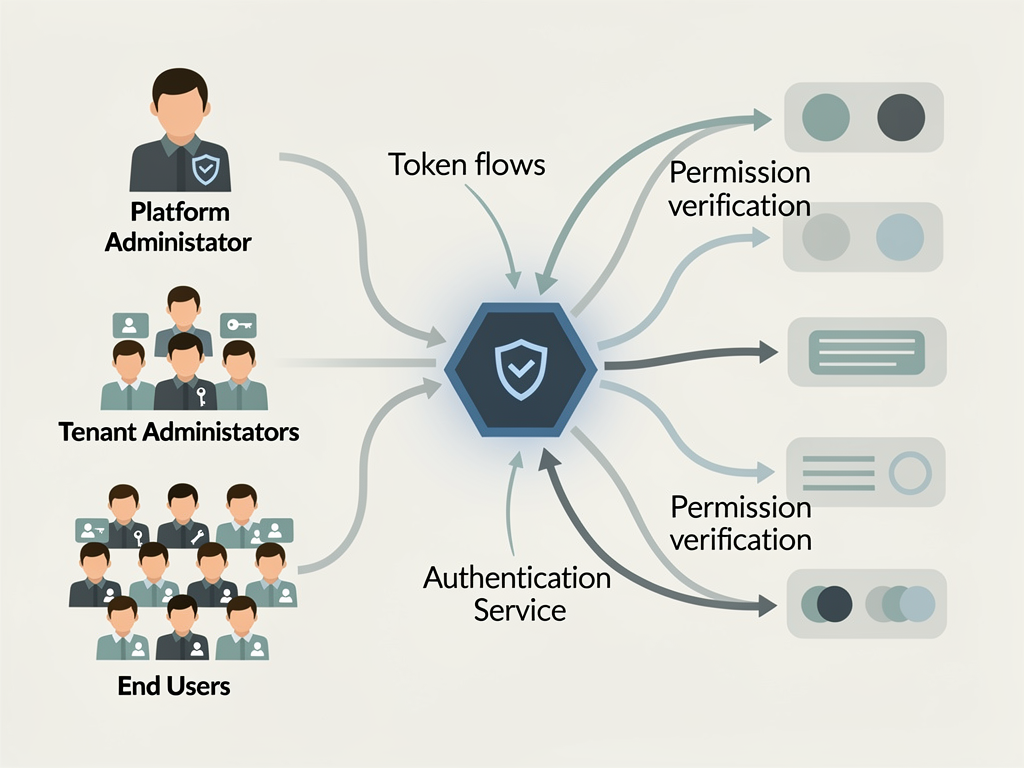
Authentication in multi-tenant SaaS platforms presents unique challenges that go beyond standard user login flows. You must manage multiple user types (platform admins, tenant admins, tenant members, and potentially end users of tenant applications), implement appropriate access controls for each role, and handle authentication across custom domains seamlessly.
The complexity multiplies when you consider features like:
- Single sign-on (SSO) for enterprise tenants who want to use their existing identity providers
- Team invitations that allow tenant admins to add users to their accounts
- Role-based access control with granular permissions that can be customized per tenant
- Session management across multiple domains and subdomains
- API authentication for programmatic access to tenant resources
Building these features from scratch requires expertise in security best practices, token management, and the specific authentication protocols (OAuth 2.0, SAML, OpenID Connect) that enterprise customers expect. Security vulnerabilities in authentication systems can be catastrophic, making this an area where leveraging battle-tested implementations is particularly valuable.
Modern authentication solutions like NextAuth (now Auth.js) provide robust foundations for authentication, but integrating them into multi-tenant architectures requires additional work. A Next.js SaaS template that includes pre-built multi-tenant authentication saves significant development time while ensuring security best practices are followed.
Payment Processing and Subscription Management
Monetization infrastructure is another area where the build versus buy decision has significant implications. At minimum, a SaaS platform needs subscription management, payment processing, invoice generation, and usage tracking. For platforms that enable clients to monetize their own applications, the complexity increases further.
Stripe has become the de facto standard for SaaS payment processing in the US market, offering robust APIs for subscriptions, metered billing, and marketplace payments. However, integrating Stripe properly requires substantial development effort:
- Webhook handling for subscription lifecycle events (created, updated, canceled, payment failed)
- Customer portal integration for self-service subscription management
- Proration logic for mid-cycle plan changes
- Tax calculation for compliance with varying state and local requirements
- Dunning management for failed payment recovery
For platforms that enable tenants to accept payments from their own users, you need Stripe Connect integration with appropriate account types (Standard, Express, or Custom), payout management, and platform fee collection. This adds another layer of complexity that can consume weeks of development time.
A SaaS starter kit with pre-built Stripe integration handles these complexities out of the box, implementing best practices for webhook handling, subscription management, and customer communication. This allows founders to launch with robust monetization infrastructure without building it from scratch.
Infrastructure and Hosting Decisions
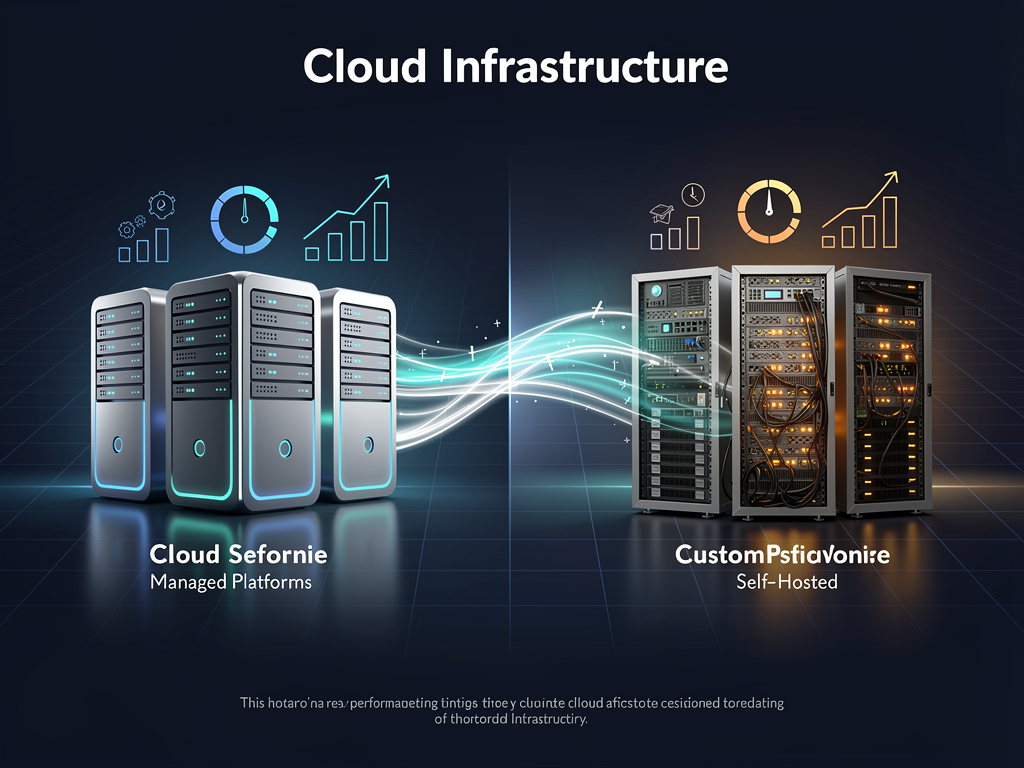
The choice of hosting infrastructure significantly impacts both costs and operational complexity. Cloud providers like AWS, Google Cloud, and Azure offer virtually unlimited scalability but require expertise to configure and optimize. Managed platforms like Vercel and Netlify simplify deployment but may become expensive at scale.
For cost-conscious founders, self-hosting options deserve serious consideration. Modern tools like Coolify and Dokku make self-hosting on VPS providers like Hetzner or DigitalOcean increasingly accessible. A well-configured self-hosted setup can reduce infrastructure costs by 80-90% compared to managed platforms while maintaining excellent performance and reliability.
Consider this cost comparison for a growing SaaS platform:
| Hosting Approach | Monthly Cost at 10K Users | Monthly Cost at 100K Users |
|---|---|---|
| Vercel Pro + Managed DB | $150-300 | $1,500-3,000 |
| AWS (optimized) | $100-200 | $800-1,500 |
| Self-hosted (Hetzner + Coolify) | $15-50 | $100-300 |
The tradeoff is operational complexity. Self-hosting requires monitoring, backup management, security patching, and incident response capabilities. For early-stage startups with limited engineering resources, the simplicity of managed platforms may justify the higher costs. As you scale and your team grows, migrating to self-hosted infrastructure can dramatically improve unit economics.
A comprehensive boilerplate should include deployment guides for multiple hosting options, allowing you to start with managed platforms for simplicity and migrate to self-hosted infrastructure as your needs evolve. This flexibility ensures you are not locked into expensive hosting as your platform scales.
Building Your Development Team Strategy
The build versus buy decision is inseparable from your team strategy. Building from scratch requires experienced developers who have built similar systems before. Hiring such talent is expensive and time-consuming, with average time-to-hire for senior software engineers exceeding 49 days in the current US market.
Consider the team composition required for different approaches:
Building from scratch typically requires 3-5 experienced developers working full-time for 6-12 months to reach MVP. You need expertise in frontend development, backend architecture, database design, DevOps, and security. Finding developers with multi-tenant SaaS experience is particularly challenging.
Leveraging boilerplates reduces team requirements significantly. A single experienced developer can customize a production-ready foundation and launch an MVP in weeks rather than months. This approach is particularly valuable for bootstrapped founders or small teams.
Pure SaaS adoption minimizes technical requirements but may require expertise in integration and automation tools. The challenge shifts from building to configuring and connecting multiple systems.
For many founders, the optimal strategy involves starting with a robust foundation that minimizes initial development requirements, then building internal expertise over time as the product matures and specific customization needs emerge. This approach preserves capital during the critical early stages while maintaining flexibility for future development.
Security and Compliance Considerations
Security is non-negotiable for SaaS platforms, particularly those handling customer data across multiple tenants. A security breach can destroy customer trust, trigger regulatory penalties, and potentially end your business. The build versus buy decision has significant implications for your security posture.
Building security features from scratch requires deep expertise in:
- Input validation and sanitization to prevent injection attacks
- Authentication security including password hashing, session management, and token handling
- Authorization enforcement to prevent unauthorized access between tenants
- Data encryption at rest and in transit
- Audit logging for compliance and incident investigation
- Vulnerability management including dependency updates and security patching
Production-ready boilerplates implement security best practices by default, reducing the risk of common vulnerabilities. However, security is an ongoing responsibility. You must stay current with security advisories, apply patches promptly, and conduct regular security assessments regardless of your development approach.
For platforms targeting enterprise customers, compliance requirements like SOC 2, HIPAA, or GDPR add additional complexity. These frameworks require documented security controls, regular audits, and specific technical implementations. Starting with a foundation that supports compliance requirements is far easier than retrofitting compliance into an existing system.

Time-to-Market Analysis
For most SaaS founders, time-to-market is the critical variable that should drive the build versus buy decision. Every month spent building infrastructure is a month your competitors are acquiring customers, learning from feedback, and iterating on their products.
Consider the timeline implications of different approaches:
Building from scratch: 6-12 months to MVP for a full-featured multi-tenant platform. This timeline assumes experienced developers and clear requirements. Scope creep, technical challenges, and hiring delays frequently extend this timeline to 12-18 months or longer.
Leveraging a comprehensive boilerplate: 2-8 weeks to MVP depending on customization requirements. The foundation handles authentication, multi-tenancy, payments, and admin interfaces, allowing you to focus immediately on your Core differentiators.
Pure SaaS integration: 1-4 weeks for initial deployment, but ongoing integration work and limitations may slow feature development over time.
The compound effects of faster launches are substantial. Launching three months earlier means three additional months of customer feedback, revenue generation, and market learning. For venture-backed startups, faster launches mean more runway to achieve milestones. For bootstrapped founders, faster launches mean earlier revenue to fund continued development.
Founder Insight: The best time to launch is when your Core differentiators are ready, not when every Context feature is perfect. Customers care about what makes you unique, not whether you built your own password reset flow.
Decision Framework for SaaS Founders
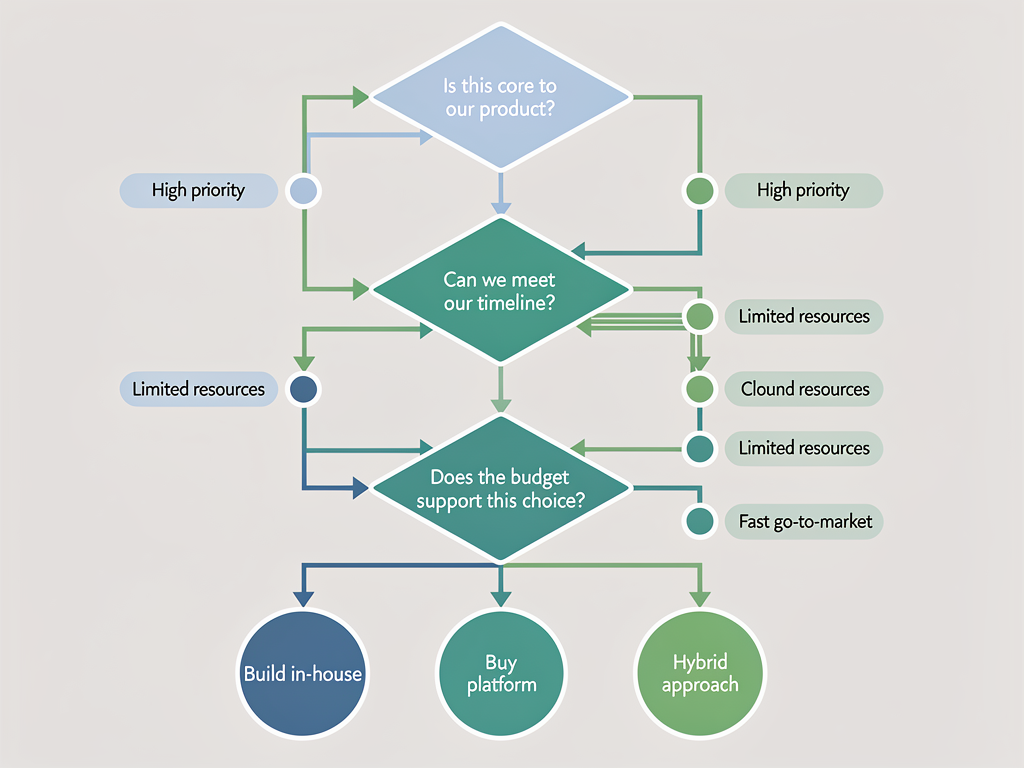
With all these factors in mind, how should founders approach the build versus buy decision? The following framework provides a structured approach to evaluating your options:
Step 1: Identify your Core differentiators. What specific capabilities will customers choose you for? These are the features where custom development investment is justified.
Step 2: Inventory your Context requirements. List all the features required to operate your platform that do not differentiate you in the market. Authentication, payments, email, admin dashboards, and basic user management typically fall into this category.
Step 3: Evaluate your constraints. Consider your timeline, budget, team expertise, and risk tolerance. Early-stage startups with limited runway should prioritize speed over customization.
Step 4: Assess available solutions. Research boilerplates, starter kits, and SaaS tools that address your Context requirements. Evaluate them based on feature completeness, code quality, documentation, and community support.
Step 5: Calculate total cost of ownership. Include development time, ongoing maintenance, subscription fees, and opportunity costs in your analysis. A solution that appears expensive upfront may be cheaper over a three-year horizon.
Step 6: Plan for evolution. Your needs will change as your platform grows. Choose solutions that provide flexibility to customize, extend, or replace components as requirements evolve.
Real-World Case Studies
Examining how successful SaaS companies have approached the build versus buy decision provides valuable perspective for founders facing similar choices.
Case Study 1: The Over-Builder
A founder spent $140,000 over fourteen months building a custom invoicing platform. The development team shipped approximately 60% of the planned features before the founder discovered that open-source alternatives existed that covered 90% of requirements. The lesson: thorough market research before building can prevent costly mistakes.
Case Study 2: The Integration Nightmare
A startup stitched together five different SaaS tools to manage client workflows. Combined subscription costs reached $900/month, and the integration complexity created constant maintenance burden. After three years, they migrated to a custom solution that cost less than the accumulated subscription fees. The lesson: integration complexity compounds over time, and ownership may be cheaper long-term.
Case Study 3: The Strategic Leverager
A no-code platform founder used a multi-tenant boilerplate as their foundation, launching an MVP in six weeks. They invested their development resources in their unique drag-and-drop interface while the boilerplate handled authentication, billing, and tenant management. Within eighteen months, they had acquired 500 paying customers and raised a seed round. The lesson: leveraging existing solutions for Context frees resources for Core innovation.
These case studies illustrate that success comes not from dogmatic adherence to build or buy, but from strategic allocation of resources based on where differentiation lies.
Emerging Trends and Future Considerations
The build versus buy landscape continues to evolve rapidly. Several trends are reshaping the options available to SaaS founders:
AI-assisted development is accelerating custom development timelines. Tools like GitHub Copilot and Claude can generate boilerplate code, write tests, and assist with debugging. However, AI tools are most effective when working within established patterns, making well-structured boilerplates even more valuable as starting points.
Composable architectures are gaining traction, allowing founders to mix and match components from different sources. Headless CMS platforms, authentication services, and payment processors can be combined with custom code to create tailored solutions without building everything from scratch.
Edge computing is changing deployment patterns, with platforms like Vercel and Cloudflare Workers enabling globally distributed applications. Boilerplates and starter kits are adapting to support these new deployment models.
Self-hosting renaissance is making owned infrastructure more accessible. Tools like Coolify, Dokku, and improved container orchestration are reducing the operational burden of self-hosting, making it viable for smaller teams.
Founders should choose solutions that position them to take advantage of these trends rather than locking them into legacy approaches.
Building for Scale from Day One
One of the most common mistakes founders make is optimizing for their current scale rather than their target scale. Decisions that seem reasonable for a platform with 10 customers become problematic at 1,000 customers and catastrophic at 10,000.
Key scalability considerations include:
Database architecture: Single-database approaches may work initially but can become bottlenecks as data volumes grow. Choose foundations that support database sharding, read replicas, or migration to distributed databases.
Caching strategies: Effective caching can reduce database load by 90% or more. Ensure your foundation includes caching patterns that can be extended as needed.
Background job processing: Long-running tasks should be processed asynchronously to maintain responsive user experiences. Queue-based architectures scale more gracefully than synchronous processing.
API rate limiting: Protect your platform from abuse and ensure fair resource allocation among tenants with robust rate limiting.
Monitoring and observability: You cannot optimize what you cannot measure. Comprehensive logging, metrics, and tracing are essential for identifying and resolving performance issues.
A well-designed boilerplate implements these patterns from the start, allowing you to scale without major architectural rewrites. This is particularly important for multi-tenant platforms where individual tenant growth can create unexpected load patterns.
The Role of Community and Support
When evaluating build versus buy options, the quality of community and support resources is often undervalued. Strong communities provide:
- Faster problem resolution through forums, Discord channels, and Stack Overflow answers
- Best practice guidance from developers who have solved similar challenges
- Plugin and extension ecosystems that extend functionality without custom development
- Hiring pipelines as developers familiar with popular tools are easier to recruit
For boilerplates and starter kits, community size correlates with code quality and longevity. Active communities contribute bug fixes, security patches, and feature improvements. Abandoned projects with no community support become liabilities rather than assets.
Evaluate potential solutions based on GitHub activity, documentation quality, response times in support channels, and the presence of third-party tutorials and resources. A solution with strong community support will serve you better long-term than a technically superior solution with no ecosystem.

Making Your Final Decision
After considering all these factors, the build versus buy decision ultimately comes down to a few key questions:
Where does your competitive advantage lie? If your differentiation is in infrastructure or architecture, building may be justified. If your differentiation is in user experience, features, or market positioning, leverage existing solutions for infrastructure.
What are your timeline constraints? If you need to launch quickly to capture a market opportunity or extend your runway, prioritize solutions that accelerate time-to-market.
What is your team's expertise? Play to your strengths. If your team has deep infrastructure experience, building may be efficient. If your team excels at product development, leverage existing infrastructure.
What is your risk tolerance? Building from scratch carries execution risk. SaaS adoption carries vendor risk. Boilerplates balance these risks by providing ownership with reduced development burden.
For most SaaS founders building multi-tenant platforms, the optimal approach involves leveraging a comprehensive boilerplate or starter kit that handles Context features while preserving flexibility to build Core differentiators. This approach minimizes time-to-market, reduces development risk, and allows you to focus your limited resources on what actually matters to customers.

Conclusion
The build versus buy decision is one of the most consequential choices SaaS founders make. The wrong choice can consume your runway, delay your launch, and saddle you with technical debt that compounds over time. The right choice accelerates your path to market, preserves your resources for differentiation, and positions you for sustainable growth.
For founders building multi-tenant platforms, no-code tools, or white-label SaaS solutions, the complexity of the required infrastructure makes leveraging existing solutions particularly attractive. Authentication, multi-tenancy, custom domains, payment processing, and admin interfaces are solved problems. Investing engineering resources in solving them again rarely makes strategic sense.
The hybrid approach, using production-ready boilerplates and starter kits as foundations while building custom features for differentiation, offers the best of both worlds. You get the speed and reliability of proven solutions with the flexibility and ownership of custom development.
As you evaluate your options, remember that the goal is not to build the most elegant infrastructure or to minimize subscription costs. The goal is to deliver value to customers as quickly as possible while building a sustainable business. Every decision should be evaluated through that lens.
The founders who succeed are not those who build everything themselves or those who buy everything off the shelf. They are the ones who strategically allocate their limited resources to maximize customer value and competitive advantage. Make your build versus buy decisions with that principle in mind, and you will be well-positioned for success.
Frequently Asked Questions
How do I know if a feature is Core or Context for my business?
The distinction between Core and Context depends on your specific business model and competitive positioning. Ask yourself: would customers choose your product over competitors specifically because of this feature? If the answer is yes, it is likely Core. If the feature is necessary to operate but does not differentiate you, it is Context. For example, if you are building a no-code platform, your drag-and-drop interface and component library are Core, while user authentication and subscription billing are Context. The test is whether customers would pay a premium for your implementation of the feature versus a standard implementation. Most infrastructure features like authentication, payments, and basic admin dashboards fail this test and should be treated as Context.
What should I look for when evaluating a SaaS boilerplate or starter kit?
When evaluating boilerplates, prioritize code quality, documentation, and community support over feature count. Examine the codebase for clean architecture, consistent patterns, and comprehensive test coverage. Review the documentation for completeness and clarity, including deployment guides and customization instructions. Check GitHub activity for recent commits, issue response times, and contributor diversity. Evaluate whether the boilerplate supports your specific requirements, particularly around multi-tenancy, custom domains, and payment processing. Consider the technology stack and ensure it aligns with your team's expertise. Finally, assess the licensing terms and ensure they permit your intended use case, including commercial deployment and modification.
How much can I realistically save by using a boilerplate instead of building from scratch?
Based on typical development timelines, a comprehensive boilerplate can save 400-600 hours of development time for core SaaS features. At US developer rates of $100-200 per hour, this translates to $40,000-$120,000 in direct development costs. However, the more significant savings often come from reduced time-to-market. Launching three to six months earlier means earlier revenue generation, more time for customer feedback and iteration, and extended runway for fundraising milestones. For venture-backed startups, the opportunity cost of delayed launches frequently exceeds direct development costs. Additionally, boilerplates reduce ongoing maintenance burden by implementing proven patterns and staying current with security updates, saving 100-200 hours annually in maintenance work.
When does it make sense to build custom infrastructure instead of using existing solutions?
Building custom infrastructure is justified when your competitive advantage depends on capabilities that existing solutions cannot provide. This typically applies to companies operating at extreme scale (millions of users), those with unique technical requirements that no existing solution addresses, or those in regulated industries with specific compliance needs that off-the-shelf solutions do not meet. Building also makes sense when you have deep infrastructure expertise on your team and the timeline flexibility to invest in custom development. However, even in these cases, a hybrid approach often works best: use existing solutions for standard features while building custom components only where truly necessary. The key is honest assessment of whether custom infrastructure actually provides competitive advantage or merely satisfies engineering preferences.
How do I handle the transition if I start with a boilerplate but need to customize heavily later?
The beauty of code-based boilerplates versus SaaS tools is that you own the code completely and can modify it as needed. Start by understanding the boilerplate's architecture thoroughly before making changes. Document your customizations carefully to facilitate future updates and onboarding of new team members. When the boilerplate releases updates, evaluate them against your customizations to determine which updates to incorporate. Over time, your codebase will diverge from the original boilerplate, which is expected and acceptable. The boilerplate served its purpose by accelerating your initial development; continued divergence reflects your unique requirements. Plan for this evolution by maintaining clean separation between boilerplate code and custom code where possible, making future updates and refactoring easier to manage.
What are the biggest mistakes founders make in the build versus buy decision?
The most common mistake is underestimating the total cost of ownership for custom development. Founders often focus on initial development time while ignoring ongoing maintenance, security updates, and the opportunity cost of delayed launches. Another frequent error is over-building Context features while under-investing in Core differentiators, essentially building a better authentication system than competitors while neglecting the features customers actually care about. Some founders fall into the opposite trap, relying entirely on SaaS tools that create vendor lock-in and subscription costs that erode margins at scale. Finally, many founders fail to plan for evolution, choosing solutions that work for their current scale but cannot grow with them. The best approach involves honest assessment of your constraints, clear identification of Core versus Context, and selection of solutions that balance speed, flexibility, and long-term sustainability.
Ready to Accelerate Your SaaS Development?
If you are building a multi-tenant SaaS platform, no-code tool, or white-label solution, you do not have to choose between building everything from scratch or cobbling together SaaS tools. NextBuilder provides a complete Next.js foundation for building multi-tenant SaaS platforms in days, not months. With built-in support for custom subdomains, SSL provisioning, dual authentication systems, team collaboration, and integrated billing, you can focus on your Core differentiators while we handle the Context. Explore the demo and see how NextBuilder can accelerate your path to market while preserving the flexibility to build exactly what your customers need.
Subscribe to our newsletter
Subscribe to our newsletter and stay up-to-date with the latest news and updates.